In the last two Field Journal entries, I wrote about women as the shock absorbers, inside and outside the workplace, and about where hypervigilance often comes from: how the scanning and bracing we do at work is not a personality trait but a nervous system that learned to read the room before it learned to trust itself.
This next one is about what I did with that kind of bracing for a long time, and what I do now instead.
For years, I found my footing by leaning on other women. That's not really a confession. It was more of a smart, human coping mechanism that kept me upright in situations that weren't built for me. When I couldn't locate my own ground, I borrowed theirs. A look across the table. A walk back to the office after a hard meeting. An email later on that said, "Did that really just happen?" These women were my regulation. They were how I fumbled my way back to my center after I felt pushed out and off kilter. Sometimes it served me. Sometimes it backfired.
What I can see now, with the benefit of time, distance, and a lot of internal work, is that I was also asking them to carry more than was fair. It’s true that we as humans regulate off of one another. But when you habitually source your steadiness from others, you start depending on their steadiness over your own. You rely on them to agree with you, to be emotionally available, to feel what you feel with the same intensity. I was creating expectations I never verbalized or requested consent for, and when those women had their own hard days, their own limits, their own lives, I felt their pivot as a kind of abandonment. That wasn't their failure whatsoever. It was mine to understand and repair. I had made my footing dependent on their footing, and that is NOT ground. That's two people standing on the same loose rock.
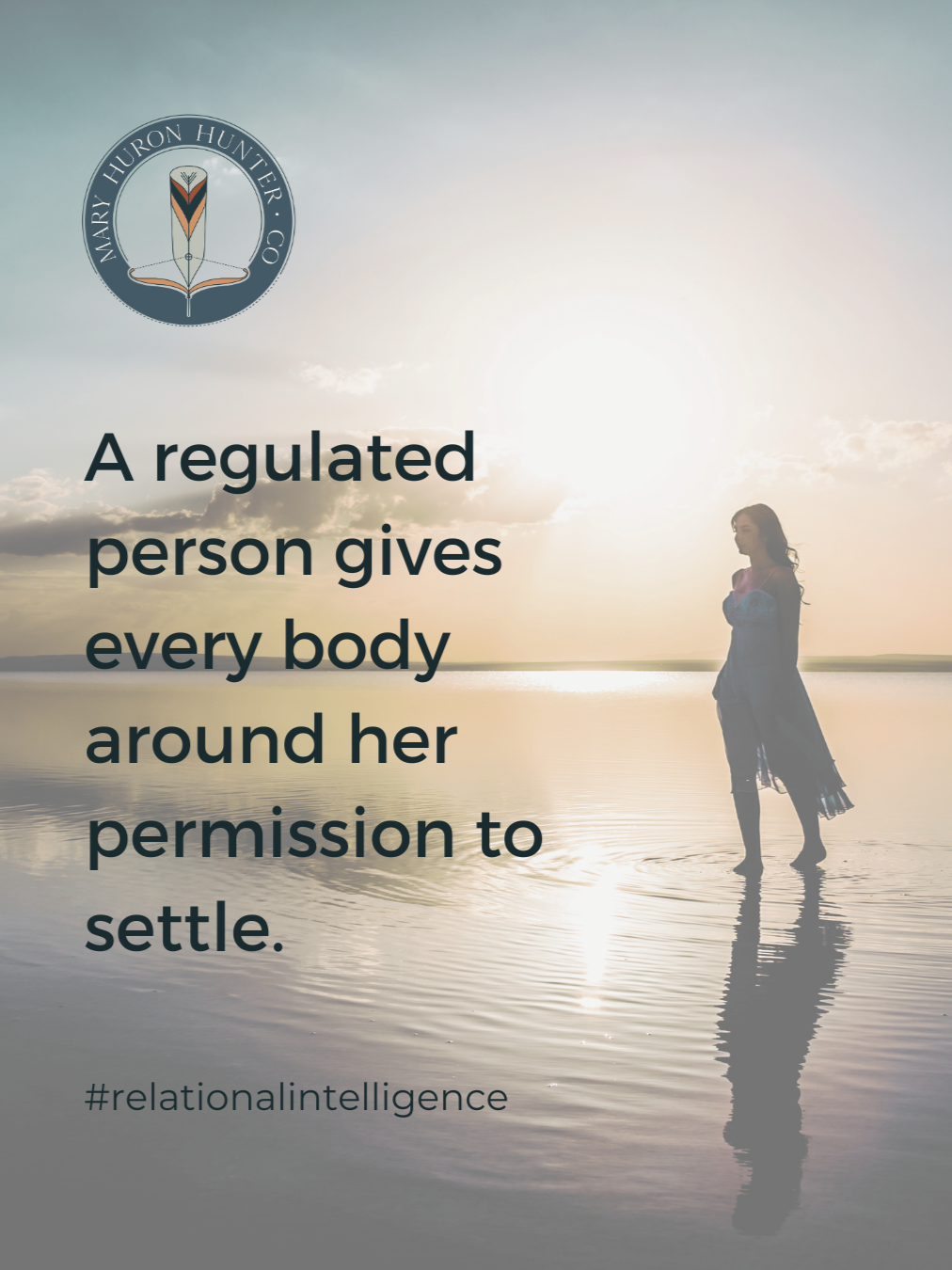
The turn for me was learning to care for myself in ways that I noticed ended up caring for other people. I used to think of self-care as something you did in private so you could go back out and give more. I think of it all very differently now. There's an idea I keep coming back to, that your purpose is not what you do but what happens in other people when you do what you do. When I began tending my own nervous system, walking before I started work, sleeping like it mattered, saying the true thing in the moment instead of three days later in an email, saying "no" instead of reflexively saying "yes," letting go of relationships and situations that were out of alignment for me, the people around me changed. Not because I fixed anything for them. Because a regulated person gives everybody around her permission to settle. That's the whole mechanism. I didn't have to absorb their stress to help them. I had to regulate myself so they could regulate themselves.
I didn't arrive at this practice easily or quickly. There was a massive explosion in my life several years ago that finally made me commit to embodying deeper truth, self-trust, and higher integrity as the daily ground I now walk on.
It was a terrible betrayal. Someone who convinced me she was a soul sister and a dear friend, who moved through my life for years persuading me that we were living parallel lives, turned out to have been trying to merge with me to get closer to something she wanted by manipulating, lying to, and deceiving me. When it all came into focus, it knocked the oxygen right out of my body. I realized I had been leaning again, this time on someone I believed carried more magic and capacity than I did. What I finally saw was that I had been outsourcing my own goodness and wholeness to someone who performed and appeared more put together than I felt. It turns out she was a golden shadow, a place for me to unconsciously project the brilliance I had disowned and couldn't yet recognize in myself.
That lesson landed hard. And it didn't stop there. What came after was, in its own way, just as difficult. The gossip. The storytelling. The truth twisting. The way my experience rippled out through a community of women and got picked up and passed along. I watched people I knew use the news of this fractured relationship for entertainment, for self-soothing, and as a way to manufacture closeness with other women, a connection built on my pain and therefore false at the root. None of those women called to ask how I was. Plenty of people talked about what they thought of me. That taught me something the original betrayal hadn't quite finished teaching, which is that a field can be eroded from the edges as easily as from the center.
I don't wish any of this on anyone, and I also wouldn't give it back. It was the wake-up call that beckoned me to build and walk the whole field I'm in now. I pulled every weed I'd been calling a flower because I was too stretched thin to look at it closely. I trimmed trees that were shading the furrows. I cleaned out the corners of my life that had been growing from convenience or history or guilt or habit. And then, with what was left, I raked up the debris, planted new seeds, and started watering. The people who were authentic, who told the truth even when it was hard, who could hold their own feelings without needing me to hold them, too. I tend that field now with a kind of discernment I didn't always have. I'm happy to say that the community around me now is smaller, more real, and definitely more alive and fulfilling.
This is what it means to tend our own fields. To keep the soil fertile and the pests out, the plants thriving, the harvest abundant, the land cared for over seasons rather than seized for a single crop. This isn't a metaphor I use lightly. The field you keep is the space you relate, regulate, and communicate from. When it's clean and clear, you can lead yourself and others with true integrity, because nothing's rotting underneath that you have to step around.
I think a lot of women are living without that discernment, and not because they're careless.
The world is designed for our productivity and our attention. Social media, sales and marketing, the 24-hour news cycle, all of it is built to shape the individual experience toward what looks like a common good but is mostly the perpetuation of systems of oppression, fear, and control themselves. If you're a woman who was raised to read the room and manage it, you are the ideal user of a world like that. You will absorb. You will consume. You will accommodate. You will make yourself responsible for outcomes that were never yours.
So the practice I teach, and the one I am still integrating myself, is emotional and relational wellness. Not toughness. Wellness the way a body comes into its own strength through repetition under reasonable load, a little at a time. The capacity to meet the weather patterns of everyday life without making every one of them a referendum on your worth, and to stay in relationship with others while you do it.
Because here is what I finally understood about every experience shared in this essay. Leaning on another woman's steadiness, taking on a friend's version of me, absorbing the chatter after the betrayal, doing more than my share so no one would be disappointed -- all of it was one move wearing different skins. I kept collapsing into someone else's ground, someone else's feeling, someone else's story, and losing contact with my own. The practice is learning to stay in my own field while someone else is fully in theirs.
At the center of that practice is one move I come back to again and again: two things can be true at the same time. Someone can be hurting in front of you, and you can keep your own feelings. Someone can fail at something, and you can decline to absorb it as your failure. A boss, a partner, a child can be flooded with emotion, and you do not have to default to their point of view in order to stay in relationship with them. I was acutely reminded of this in my own car recently, the day my daughter slammed the door in my face as I reached toward her with a loving gesture. My body's first move was the old one, to go to her, to make it right, to locate myself inside her feeling. The newer move was to stay right where I was, feel what I felt, and let her have her own experience. Both of us were allowed. Nobody had to disappear or collapse.
The question I ask now, instead of what did I do wrong, is what am I accountable for, so I can actually do something about it. That question is narrow and distinct on purpose. Some things are simply not mine to solve. You can't want something for someone more than she wants it for herself, because when the novelty wears off, it’ll be your fault it didn't work. Over-functioning is doing far more than a goal requires, and we do it because we have lost contact with our limits. When we hold everyone's share, there's no equity, and there's no room for anyone else to grow into their own capacity. Trusting others to carry their part isn't withdrawal. It's respect.
None of this is a performance, to be sure. It's a way of being. Value what you think of yourself more than what other people think of you. That sounds simple, and it's one of the hardest practices I know, because it requires emotional intelligence, a regulated nervous system, and clear, practiced communication all at once. It requires you to become, in your body, the person you want to be and say you are, truly and wholly. That's trustworthiness.
And when you need ground, by all means, reach for another woman. Just reach differently. Pick up the phone. Schedule a walk. Stand shoulder to shoulder, looking out in the same direction, each of you on your own two feet. That's not leaning or merging or co-opting. That's genuine reciprocity. That's what the field looks like when it's healthy and thriving.
AUTHOR'S NOTE: This article is part of an ongoing series on The Field for Human Communication, the work of helping people find and use their authentic voice in professional life.
"I guide women who are DONE performing leadership and are ready to embody it through The Field for Human Communication™ - the living system where humans communicate, relate, and regulate." -Mary 🌱
How this article was made
Ideas and insights: Original, drawn from lived experience, research, and field observation by Mary Huron Hunter.
Editing tool: Drafted and reviewed for syntax and style with the assistance of Claude (Anthropic AI).
Writing: Authored by Mary Huron Hunter.
Mary Huron Hunter is the founder of The Field for Human Communication™, a space for growing leadership from the inside out. Coaching, coursework, consulting, and feminine leadership guidance for the leader who is ready to stop translating herself and start communicating from who she actually is.