Your People Have Ideas They're Not Sharing With You...

And there's a good chance it's not because they don't care, or because they aren't smart enough, or because your team has a "communication problem."
It's because their nervous systems have decided that sharing is not safe. And that decision happened before a single conscious thought formed.
Last week, I wrote about what happens inside us when we don't feel safe to speak. This week, I want to turn it around: what does it mean to be the one responsible for creating that safety for others?
This is the part I listen for most often in leadership conversations and don't hear. We talk about psychological safety as though it were a culture initiative, like something you install through policy or demonstrate through values statements or build through trust-falls at the offsite. And then we wonder why, in the actual meeting, in the actual moment when you genuinely want to hear what people think, the room goes quiet. Or the same three voices fill the space. Or someone nods along and then pulls you aside afterward to say what they actually think, in a hallway, in a whisper.I have been in that hallway more times than I can count. On both sides of it, really.
The room didn't go quiet because your people lack confidence. The room went quiet because something in the environment told their nervous systems that expression was not safe. And the nervous system acts on that information before the brain has a chance to weigh in.
What is actually happening in that room
Human beings are not primarily rational creatures who occasionally get emotional. We are biological organisms whose first job, always, is survival, and whose brains developed in that order. The oldest structures, the brainstem and the limbic system, are scanning for threat continuously, below the level of conscious awareness. At home. At work. Everywhere. The newer structures, the prefrontal cortex, where language and reflective thought and authentic expression live, are available only when the older structures have determined that it is safe to come online. Again, everywhere all the time.
Stephen Porges, whose Polyvagal Theory has reshaped how we understand the nervous system, uses the term neuroception to describe this process: the body's automatic, subconscious reading of the environment for cues of safety or danger. Neuroception is faster than thought. It is reading your voice, your face, the pace of the room, the quality of your attention, the history of what has happened in spaces like this one. It is deciding, before anyone speaks a word, whether this is a place where expression will be rewarded or punished.
When neuroception registers safety, the ventral vagal branch of the nervous system activates. Heart rate steadies. Breathing deepens. The facial muscles soften. The prefrontal cortex comes fully online. The person in front of you can think, reflect, and speak from a real, integrated place. This is the state where ideas surface. Where creative thinking happens. Where someone takes the risk of saying the thing that turns out to be the thing the whole team needed to hear.When neuroception registers threat, the body mobilizes. The sympathetic nervous system takes over. The prefrontal cortex loses resources. Language becomes reactive, self-protective, or disappears entirely. That capable, thoughtful person in your meeting suddenly cannot find their words, not because the words aren't there, but because the biology of threat has moved those resources somewhere else.
This is also worth naming in the context of remote and hybrid work: online, the nervous system is doing more work with less signal. Vocal warmth, genuine eye contact, and unhurried pacing matter even more when the screen has already flattened so much of what the body would otherwise use to feel safe. The antidote isn't avoiding the camera. It's knowing that in virtual spaces, your own regulation has to do more of the heavy lifting because the screen has already taken so much off the table that your body would otherwise be transmitting for free. This is not a character flaw. This is a human nervous system doing exactly what it was designed to do.
You are a co-regulator, whether you know it or not
Here is what this means for you as a leader. Your nervous system is not neutral in that room. It is actively shaping the state of every other nervous system present.Porges' research on co-regulation shows that calm, present, genuinely attuned nervous systems in proximity to activated ones support the activated system's return to safety. The inverse is equally true. A leader who arrives tight, distracted, or impatient, whose attention keeps sliding to their phone or their own next point, is broadcasting that information continuously through vocal tone, facial expression, and the quality of their listening. And every nervous system in the room is reading it.
You can have all the right values. You can say all the right words about wanting input, about there being no bad ideas, about your open door. And if your own nervous system is dysregulated, the room will know before you've finished the sentence. Not because your people are reading you consciously. Because their bodies are.
This is one of the most important and least discussed dimensions of leadership. The environment you create for your team is not primarily a structural thing. It is a physiological thing. It begins in your own body.
I want to be transparent about something here. Understanding this, really sitting with it, was humbling for me. I had to look at rooms I'd led and ask myself what I'd actually been broadcasting, separate from what I intended. The answer was not always comfortable. (My family can attest to this as well. Ouch.)
What safety actually looks like
So what does a regulated, safety-creating leader do, practically? Not in theory, but in the room, the meeting, the real and imperfect conditions of organizational life?
The signals that the nervous system reads as safe are more consistent than we might expect.
Vocal prosody matters more than most leaders realize. A voice with warmth, genuine variation, and unhurried pacing tells the nervous system it is okay to come out. The tight, flat, controlled voice, even when the words are kind, registers differently.
The face matters, too. Genuine engagement with what someone is actually saying, rather than the practiced neutrality of someone already planning their next point, is a safety signal.
Eye contact that connects rather than evaluates. Pace that is slower than feels comfortable, and then a little slower than that.
Predictability is a regulation tool. A nervous system relaxes into rhythm and consistency. Meetings that begin the same way, processes that are transparent, leaders who name what they're doing and ask permission before moving into new territory.
All of this reduces what Porges calls the neuroceptive load, the body's constant monitoring for surprise and threat.
And then there is presence. Genuine, unhurried, embodied presence. The kind where the person speaking can feel, physically feel, that they have your full attention. That you are dropped in, awake and alive...right there with them. This is not a technique. You can't manufacture it. It either comes from a genuinely regulated place or it reads as performance. The nervous system knows the difference, every single time.
Before you lead (your own regulation first)
Do a breath practice before any high-stakes meeting: 2-3 slow cycles with the exhale longer than the inhale. This is vagal tone activation, not just calming down.
Do a quick body scan: feel your feet on the floor, the weight of your body in the chair, one thing you notice in your body without fixing it. This is the return to your own regulated state.
Ask yourself honestly: what state am I actually in right now? Not what state do I want to be in. What is true?
If you're activated, move first. A short walk, shaking out your hands, orienting in the space (look around, notice what you see). Incomplete stress cycles need physical discharge before you can regulate down.
In the room
Slow your pace down. More than feels comfortable. Then a little more. Urgency is a threat signal.
Let your face actually respond to what people are saying. The practiced neutral expression of a "good listener" can read as a dorsal shutdown to a nervous system looking for connection cues.
Use your voice with warmth and variation. A flat, tight, or overly controlled voice registers as unsafe even when the words are kind.
Name what you're doing before you do it. "I want to shift us to a harder question," or "I'm going to push back here," reduces the neuroceptive load. Surprise activates threat.
Ask permission before moving into new territory. It sounds small. To the nervous system, it is significant.
When someone speaks, finish receiving what they said before you respond. The pause is not empty. It signals that you were actually there for it.
For creating ongoing safety over time
Start meetings the same way consistently. Predictability is a regulation tool.
When something goes wrong, name it clearly and move. Prolonged uncertainty is a chronic threat.
Notice who is not speaking and create conditions, not pressure. There's a difference between "what does everyone else think?" (social pressure) and slowing the room down enough that more nervous systems feel safe to enter.
After a hard conversation, check in with your own body before the next thing. Leaders who string activation together without recovery narrow their own window over time, and the room will feel it.
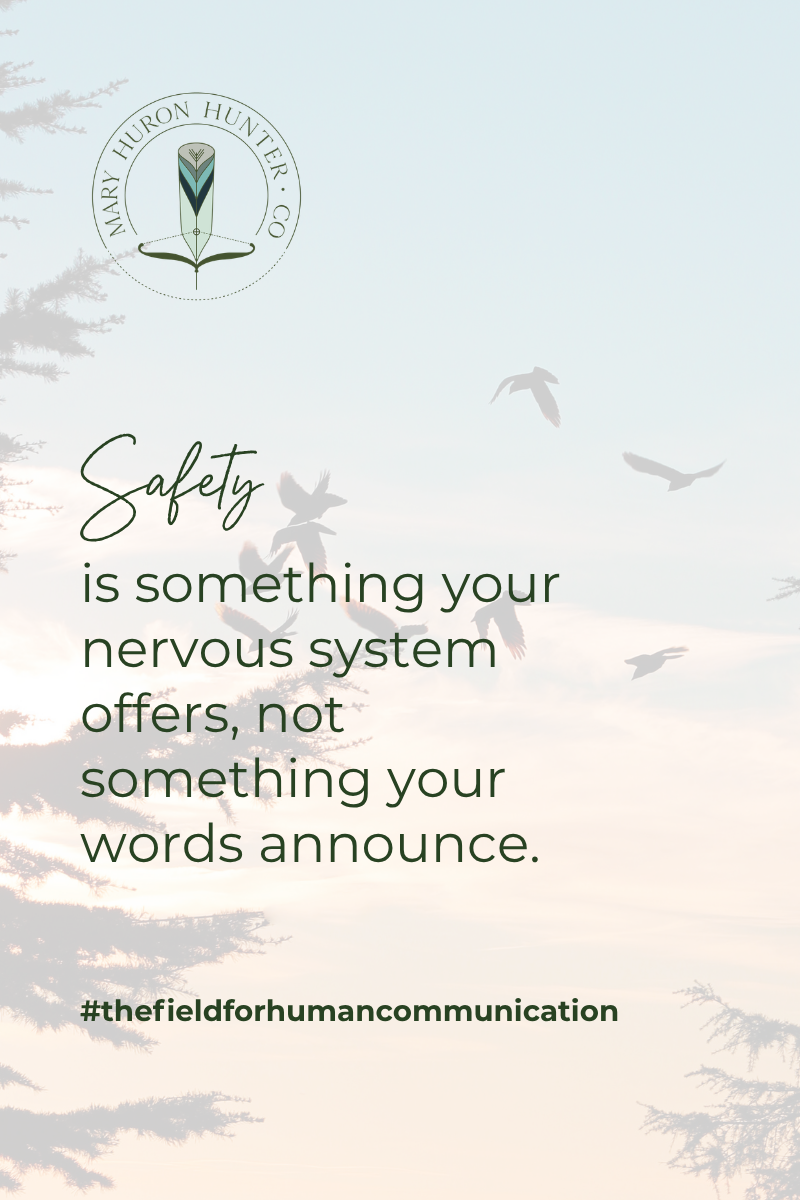
The thread running through all of these: safety is something your nervous system offers, not something your words announce. The practices build the physiological foundation for that offer to be real.
The meeting that changes things
None of this is about creating conditions that are artificially comfortable. We have enough going on right now in the artificial realm, right? A regulated nervous system is not a passive one. People can be challenged, stretched, and sit inside productive disagreement, all within a window of real safety. The difference is whether that stretch is happening inside a nervous system that trusts the environment, or inside one that is running a survival strategy.
The ideas your team is not sharing are in there. The perspective that would shift the project, the question that would catch the error before it becomes a crisis, the creative leap that nobody is taking because nobody is sure the ground is solid. It is all sitting inside a nervous system that is waiting for the signal that it is safe to speak.
That signal is not a policy. It's not a framework you implement at the next all-hands. It is what your nervous system communicates, continuously, to every person in the room with you.
The question worth sitting with: what state are you actually bringing into the spaces you lead? Not what you intend to communicate, not what you hope they feel, but what your body is broadcasting before you've said a word.
Your people's nervous systems are already reading the answer.
AUTHOR'S NOTE: This article is part of an ongoing series on The Field for Human Communication, the work of helping people find and use their authentic voice in professional life.
How this article was made...
Ideas & Insights: Original; drawn from lived experience, research, and field observation by Mary Huron Hunter
Outline & Structure: Developed with the assistance of Claude (Anthropic AI)
Writing: Authored by Mary Huron Hunter
Mary Huron Hunter is the founder of The Field for Human Communication™ — a space for growing leadership from the inside out. Coaching, consulting, and feminine leadership guidance for the leader who's ready to stop translating themselves and start leading and communicating from who they actually are.