Feminine Leadership Isn't NEW.
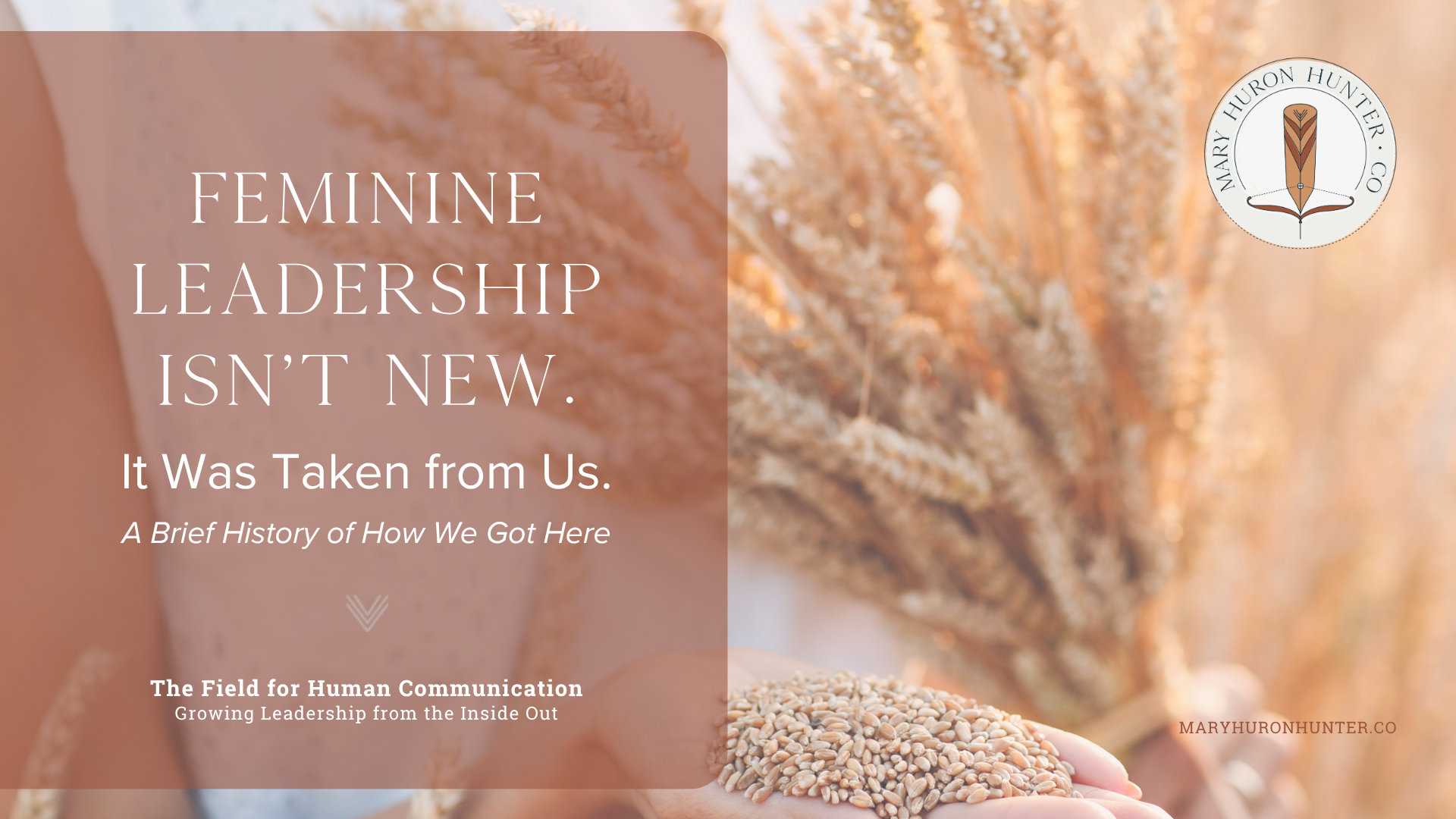
It was taken from us.
Something is wrong. Most of us can feel it, in the tightness across our shoulders that a day off never quite resolves, in the guilt that shows up the second we sit still or don't finish crossing off our to-do list, in the sense that we're always behind, always producing too little, always running out of time.
We've been conditioned to call that a personal problem, or an issue with discipline, or with our daily routine.
It's not, dammit. It's 500 years old. And you can't fix a 500-year-old wound with a different approach to productivity.
LISTEN TO THE SHORT STORY HERE ↓
For most of my life, the first thing I did every morning was check who needed me. Before water, before my feet even hit the floor, my hand was reaching for the phone to find out where I was needed first.
I used to call that being responsive. Or disciplined. Or just how I'm wired.
Then I started tracing where that reflex actually came from, and the trail didn't end in my inbox or my childhood. It kept going... back about five hundred years, through fenced-off land, through women punished for speaking plainly, through a stopwatch deciding a body couldn't be trusted to know its own rhythm.
When I think of all the ways I reflexively obeyed and complied throughout my life, I cringe. And I hold that younger one in me with a lot of compassion. We didn't understand then what we remember now.
I wrote about the history of women's work in The Field Journal this week.
It's about why feminine leadership isn't new and never was. It was taken from us. And our voices were among the first things they came for, because a woman who could speak plainly, in her own body, was a woman who couldn't be governed. That's why this is communication work before it's leadership work.
And why getting it back starts in the body, not the calendar.
I'm retraining myself to turn inward before I turn outward. It's hard work. A practice. And I am ALL in. 🏹
What's the first thing you do each morning habitually?
DOWNLOAD THE DEEPER HISTORY HERE.
Here's the story...Before capitalism, before the factory, before the clock owned anybody's body, there was the commons. Shared land, tended together, not owned. Women held a huge piece of that world directly, through the herbs, the midwifery, the knowledge of the body and its rhythms, the whole daily work of holding a community together. That work wasn't just labor. It was leadership. It just wasn't called that, because nobody needed a name for the thing everyone was already doing.
Then came the enclosures. Between the 15th and 18th centuries, the land was fenced off, privatized, handed to owners, and the people who'd subsisted on it together for generations were suddenly landless. And here's the part that doesn't make it into most history classes: the enclosure of the land ran alongside a second enclosure, of women's bodies. The feminist scholar Silvia Federici traces this in Caliban and the Witch; the same centuries that fenced the fields also fenced women's speech, women's movement, women's knowledge.
The instrument of that second enclosure was the witch hunt. Somewhere between 40 and 60 thousand people were executed as witches across Europe, the overwhelming majority of them women. We were taught to think of this as superstition, a more ignorant time. It wasn't ignorance. It was precision. The women accused were disproportionately healers, midwives, women who lived outside a household's control, women who held the kind of communal power a capitalist workforce couldn't afford to leave standing. Break that power, and you get a population that stays small, quiet, and pleasing. Just what the system ordered. We still call that fawning. We rarely trace it back to where it started.
While the witch hunts were breaking women's bodily authority, a theological shift was giving the whole system its spiritual fuel. Max Weber's The Protestant Ethic and the Spirit of Capitalism names it plainly: Calvinist doctrine turned worldly success into a sign of God's favor, and idleness into sin. Work became a calling. Rest became suspect. We don't use that language anymore, but the residue is everywhere, in the guilt that follows rest, in the pride of overwork, in "I've been so busy" delivered like a badge.
Then the clock arrived and took the last thing the body had left, which was its own rhythm. The historian E.P. Thompson calls what came before "task-orientation," where you worked until the work was done, then you rested, and time followed the season and the light. The factory replaced that with an owner's clock. Your body was required to hold a steady output regardless of hunger, grief, weather, or the ordinary rise and fall of a person's energy. And Frederick Taylor finished the job, breaking every motion into its smallest parts and deciding, with a stopwatch, that a worker's own instinct about how to move couldn't be trusted either.
Here's what none of this history usually says out loud, and it's the piece I think matters most. That machine didn't just take the land, the labor, the time. It took our nervous systems.
Our bodies were built to regulate the way they'd always regulated, in the presence of other people, in rhythm with the seasons, not against them. The commons wasn't only an economy. It was co-regulation, a whole village settling itself in relationship. Sever that, on purpose, over centuries, and you don't just lose income. You lose the actual infrastructure of felt safety. Push a body to override its own rhythm and its own signals long enough, and you get a culture with almost no room left in the middle, wired for anxiety on one edge or numbed out on the other, instead of the settled, connected place where real thinking, real relationship, and real leadership actually happen.
I want to be mindful here, because it would be easy to overstate this. I can't tell you a specific historical event changed anyone's biology in a way that passed directly through the generations that followed. What I can tell you, with real confidence, is that patterns of fear and appeasement and disconnection get carried the way most human patterns get carried. Through culture. Through parenting. Through work. Through what a body watches happen to the people before it and almost by osmosis, learns to do the same response. That's a clear claim, and it's still enough to explain a great deal of what we're carrying. Heavily and habitually, I might add.
And underneath all of that unpaid, uncounted, undervalued labor sat an entire invisible economy that never stopped running. Women's care work still adds an estimated 10.8 trillion dollars to the global economy every year, more than three times the size of the entire tech industry, and virtually none of it shows up in GDP. It was never an accident. A workforce that needed to be disciplined also needed, quietly, someone feeding it, clothing it, and raising the next round of it for free.
Here's the part that matters to me the most, and it's not a call to go backward. Trust me. There was no perfect commons waiting for us, and nostalgia was never the assignment here. But in times like these, returning to our inherent wild nature isn't regression. It's restoration. The blueprint never left.
This is what I mean when I say feminine leadership. Not a leadership style reserved for women, and not the opposite of strength. It's the leadership model the commons already practiced before it became enclosed: power that moves through relationship instead of over it, authority that comes from being regulated enough to hold a room instead of dominate it, knowledge that lives in the body and gets trusted instead of overridden. It was never missing. It was buried, on purpose, by the exact machine we've just traced.
And communication was one of the first things they came for. Women's speech, movement, and social relationships were the parts of the commons the witch hunts controlled most tightly, because a woman who could speak plainly, in her own body, with her own authority, was a woman who couldn't be governed. So, to me, this is also communication work, not just leadership work.
Before it's a language event, communication is a nervous system event, and reclaiming feminine leadership starts with reclaiming a voice that's actually communicating from a settled body instead of performing safety it doesn't feel.
Our bodies still know how to do this. Still know cyclical rhythm. Still know how to co-regulate in the presence of another settled system. Still know exactly what they're telling us, if we're willing to listen instead of override. None of it needs to be invented. It needs to be uncovered and reclaimed.
Your body was never the problem. It's been telling the truth about an unsustainable design for five hundred years. The only question left is whether we're finally ready to build something that listens back.
What would it look like to lead one part of your week from what your body already knows, instead of what the clock says it should be doing?
For me, it's starting my day differently. Not jumping straight into messages to see who needs me first. Before I've even gotten out of bed or had a glass of water. It's needing and wanting and tending to myself first.
Retraining myself to turn inward instead of outward as THE order of operations for everything is hard work. A practice. A ritual. And it's the necessary work of unraveling from the systems that are breaking under our feet because they were never built for us in the first place. When I think of all the ways I reflexively obeyed and complied throughout my life, I cringe. And I hold that younger one in me with a lot of compassion. We didn't understand then what we remember now. It's time we built a new (old) way...I am ALL in. You?
AUTHOR'S NOTE: This article is part of an ongoing series on The Field for Human Communication, the work of helping people find and use their authentic voice in professional life.
How this article was made...
Ideas & Insights: Original; drawn from lived experience, research, and field observation by Mary Huron Hunter
Editing Tool: Reviewed for syntax and style with the assistance of Claude (Anthropic AI)
Writing: Authored by Mary Huron Hunter
Mary Huron Hunter is the founder of The Field for Human Communication™ — a space for growing leadership from the inside out. Coaching, consulting, and feminine leadership guidance for the leader who's ready to stop translating themselves and start leading and communicating from who they actually are.