Breaking the Apology Habit: The Power of NOT Saying, “I’m Sorry”
I notice it almost immediately when I begin working with a new client...particularly women leaders, creatives, and changemakers. We'll be mid-conversation, and I'll ask them to take up more space in the room, to stand wider, to let their voice resonate. And before their body has even fully shifted, the words tumble out: "Sorry."
"Sorry, is this right?" "Sorry, am I doing this wrong?" "Sorry, I'm not sure I understand."
But here's what's fascinating: their mouths say "sorry" while their bodies are already contracting. Shoulders rounding inward. Chest collapsing. Eyes dropping to the floor. The apology isn't just a word; it's a full-system response that began in the body before language even caught up.
This is the somatic truth we often miss: apologies aren't just verbal habits. They're embodied patterns wired into our nervous systems through years of relational conditioning.
The Body Remembers What Words Repeat
When we understand communication through an embodied lens, we recognize that every word we speak carries the signature of our nervous system state. Are we in a calm, regulated state where we can speak from choice and clarity? Or are we in a stress response, subtle or overt, where our language becomes a survival strategy?
For many of us, especially those socialized as women, the habitual "sorry" is a fawn response. Fawning...the lesser-known cousin of fight, flight, and freeze...is our nervous system's attempt to maintain connection and safety by minimizing our presence, our needs, our impact. It's the body saying: "I'll make myself smaller so you'll still like me. I'll apologize preemptively so you won't be angry with me. I'll manage your comfort before my own truth."
These patterns don't develop in a vacuum. They're encoded through:
Early relational experiences where speaking up led to withdrawal of love or approval
Cultural conditioning that teaches girls to be accommodating, pleasant, non-threatening
Professional environments where assertiveness in women is labeled "aggressive" while the same behavior in men is called "leadership"
Systemic inequities that punish women - especially women of color, queer women, disabled women - for taking up space
Your body learned, very intelligently, that apologizing helped you stay safe and connected. And your nervous system has been running that program ever since.

How Stress States Shape Our Communication
When our nervous system perceives a threat, even the micro-threat of potential judgment or conflict, our communication shifts before we're consciously aware of it. Here's what this looks like:
In Fight/Flight Activation:
Language becomes rushed, urgent, over-explaining
Vocal tone rises in pitch and speed
Body posture becomes rigid or agitated
Apologies serve as verbal shields: "Sorry to bother you, but..."
In Freeze/Shutdown:
Words get stuck or trail off
Voice becomes smaller, flatter
Body collapses inward, gaze averts
Apologies fill silence: "Sorry, I'm just... sorry, never mind."
In Fawn Response:
Language centers the other person's comfort over authentic expression
Vocal tone becomes overly pleasant, accommodating
Body language mirrors and minimizes
Apologies smooth over any possible friction: "Sorry if this is too much..."
The body is doing what bodies do brilliantly: trying to navigate relationship while managing perceived threat. But when these responses become our default setting, we lose access to grounded, authentic communication.

The Hidden Cost: Emotional Labor and Relational Equity
Here's where this pattern becomes more than a personal quirk; it becomes a structural issue affecting teams, partnerships, and movements.
When certain people (disproportionately women, people of color, and other marginalized folks) are constantly apologizing, shrinking, and managing others' comfort, the emotional labor of maintaining relational harmony becomes deeply unequal.
I see this play out in countless ways:
The team member who apologizes before sharing a brilliant idea, softening its impact before it's even considered.
The partner who says "sorry" as a reflex when their needs conflict with someone else's, teaching others that their needs are inherently burdensome.
The leader who undermines her own authority with, "Sorry, just to piggyback on that..." instead of claiming her expertise.
This isn't just about being "too nice*." It's about how habitual apologizing:
*(we'll revisit nice v. kind in a future post...)
✗ Distributes the work of relationship maintenance unequally
✗ Makes one person responsible for managing everyone else's emotional state
✗ Diminishes the apologizer's presence, authority, and impact
✗ Trains others to expect deference rather than mutuality
✗ Reinforces power imbalances rather than transforming them
When we address this solely as a "communication skill" issue, we miss the deeper truth: this is about whose bodies have been conditioned to carry the burden of relational ease.
Recalibration: Coming Home to Grounded Presence
So how do we shift this? Not through willpower or harsh self-correction (which only activates more stress), but through gentle, consistent nervous system regulation and embodied awareness.
1. Notice Without Judgment
Start by simply tracking your apologies for a few days. Not to shame yourself, but to gather data. Notice:
When do apologies arise?
What's happening in your body right before?
What might your nervous system be responding to?
This awareness itself begins to create space between stimulus and response.
2. Ground Before You Speak
Before important conversations or moments when you typically apologize, practice:
Feet on floor: Feel the ground beneath you, notice your weight distributing evenly.
Lengthen spine: Imagine a gentle string lifting you from the crown of your head.
Three deep breaths: Exhale longer than you inhale to signal safety to your nervous system.
Soften shoulders: Let them drop away from your ears.
When you speak from this grounded state, different words emerge naturally.
3. Replace Without Apologizing
Practice alternatives that maintain warmth while honoring your presence:
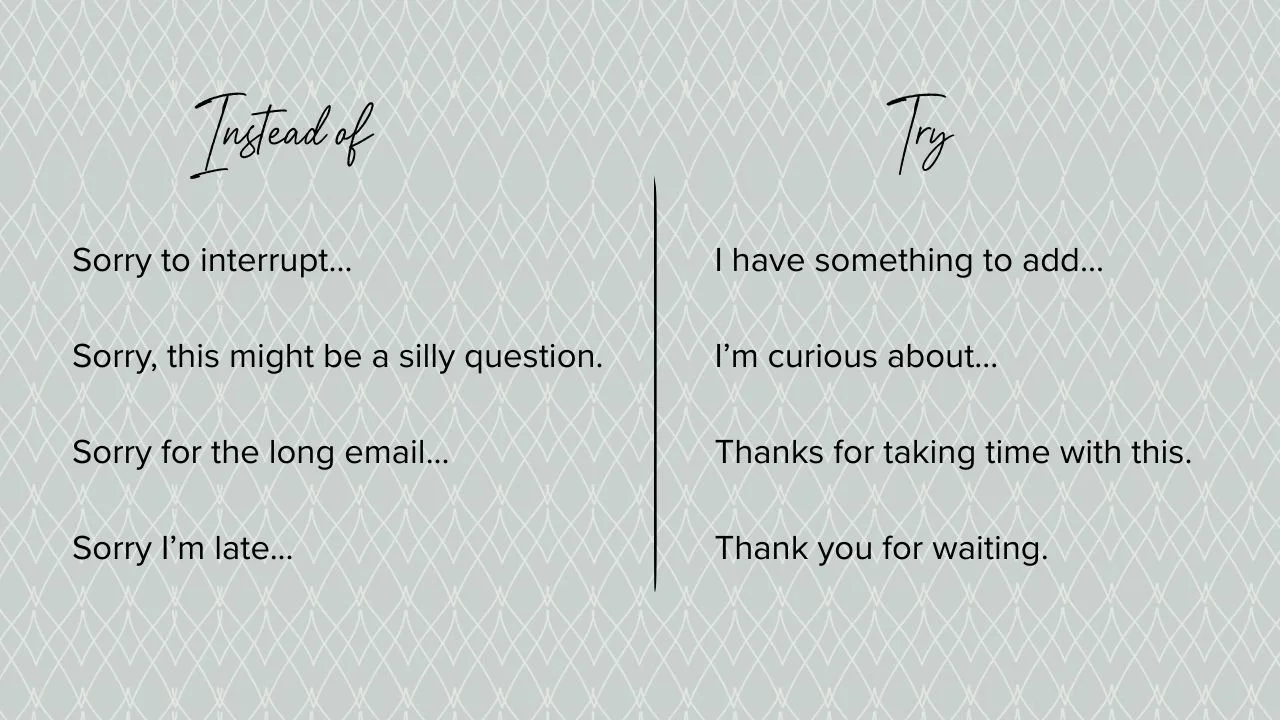
Notice how these alternatives keep connection while not making yourself small.
4. Reclaim Your Nonverbal Power
Your body speaks louder than your words. Practice:
Taking up space: Stand or sit with your full width, not collapsing inward.
Making eye contact: Meet others' gaze with warmth and steadiness.
Slowing down: Let your words have breath and pace.
Gesturing openly: Use your hands to emphasize rather than apologize.
Notice your foot position: are your toes turning inward (discomfort) or pointing forward or outward (confidence)?
5. Tend to Your Nervous System Daily
These practices help regulate your baseline state so you're less reactive:
Movement that feels good (walking, dancing, stretching)
Humming or singing to stimulate vagal tone
Time in nature or with beloved others
Practices that help you feel connected to something larger than immediate threat
The Invitation
Here's what I want you to know: You don't need to apologize for taking up space in this world.
Your voice matters. Your needs matter. Your presence matters.
Not because you've made yourself small enough to fit. Not because you've managed everyone else's comfort first. But because you are here, and your being here is enough.
The work of recalibrating our apology patterns isn't about becoming aggressive or uncaring. It's about coming back to authentic communication where connection happens through mutual presence, not through one person's perpetual diminishment.
It's about letting your nervous system know: You are safe to be seen. You are safe to take up space. You are safe to speak your truth without making yourself small first.
This is embodied communication. This is how we change not just our words, but the relational patterns that shape our teams, our families, our movements, our world.
Your body has been carrying these patterns faithfully, trying to keep you safe and connected. Honor that intelligence. And then, gently, teach your system a new way—one breath, one grounded moment, one unapologized truth at a time.
With you in the practice,
Mary
Want to explore this work more deeply? Embodied communication coaching helps you recognize these patterns in real-time and develop new, grounded ways of showing up in conversation, leadership, and relationship. The body knows the way; we just need to listen.